
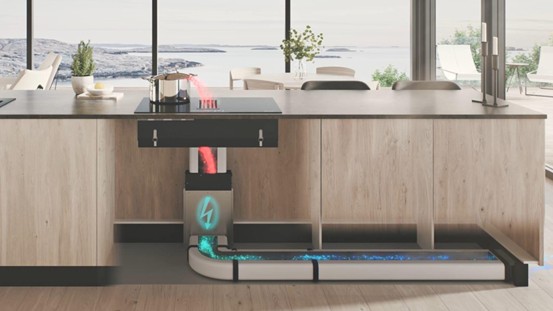
An induction hob with integrated extractor combines induction cooking and kitchen ventilation in one appliance. Instead of installing a separate overhead cooker hood, the extraction system draws steam, grease particles and cooking odours downwards through an integrated intake.
This can create a cleaner kitchen island, preserve open sightlines and simplify the appliance layout in an open-plan room. This guide explains how integrated extraction works, which specifications matter and what to confirm before selecting a venting hob for a UK kitchen or OEM project. For the complete model range, see our guide to induction hobs with built in extractor.
A Two-in-One Solution for Modern Kitchens
Conventional kitchens usually treat cooking and ventilation as two separate appliances. An induction hob with extractor combines both functions in one coordinated unit.
- No conventional overhead cooker hood is required when the selected appliance and installation are suitable.
- The area above the cooking surface remains visually open.
- Kitchen island layouts can preserve clear sightlines into dining and living areas.
- Cooking and extraction controls can be coordinated within one appliance.
- Lighting and ceiling design can be planned without working around a large overhead hood.
These benefits make integrated extraction particularly relevant to contemporary UK homes, kitchen studios, property developers and appliance brands developing differentiated product ranges.
How Downdraft Extraction Works
A downdraft cooking system extracts air close to the cooking zones. Cooking vapours pass through a grease filter and, where specified, additional odour filtration before being ducted outdoors or returned to the kitchen in recirculation mode.
The extraction point is integrated into the hob rather than positioned high above it. However, actual performance depends on more than the appliance category. Airflow, fan speed, filter design, duct diameter, duct route, cabinet clearance and installation quality all affect how effectively the system works.
When comparing products, review extraction performance and cooking performance together rather than judging the hob only by its maximum airflow figure.
Why Extractor Hobs Suit Kitchen Islands
Kitchen islands are often the visual centre of an open-plan home. An overhead cooker hood can interrupt views, reduce ceiling flexibility or make the cooking area feel enclosed.
Hobs with integrated extraction offer an alternative design approach. They are especially relevant where the kitchen island is connected to a dining or living area, provided that the extraction configuration, ducting route or filter arrangement can be accommodated correctly.
For designers and developers, the appliance can help maintain a more consistent visual line across the island. For homeowners, the main advantages are the integrated appearance and the ability to avoid a separate overhead hood in suitable layouts.
Induction Cooking Performance to Compare
Induction cooking transfers energy directly to compatible cookware, giving responsive heating and precise control. An extractor hob combines that cooking response with integrated ventilation.
When comparing different models, review the complete cooking and extraction specification:
- Number and layout of induction cooking zones
- Total and individual zone power
- Booster availability and power-sharing behaviour
- Number of cooking power levels
- Touch or slide control configuration
- Timer, child lock, pan detection and automatic shut-off functions
- Extraction speed settings and airflow
- Noise level at relevant operating speeds
- Grease and odour filter requirements
Ducted vs Recirculating Extraction
Extractor hobs may support ducted extraction, recirculation or both, depending on the model.
Ducted Extraction
Ducted extraction discharges cooking vapours outside through suitable ducting. The design must provide an appropriate route, duct diameter, termination point and space within the cabinetry or floor structure.
Recirculation Extraction
Recirculation passes air through grease filtration and, where specified, activated-carbon odour filtration before returning it to the kitchen. This can be useful where external ducting is unavailable, but it does not remove moisture in the same way as external extraction. Suitable room ventilation remains important.
Always confirm which extraction modes the selected model supports and whether filter kits are included or supplied separately. For model-level guidance, review the ducted and recirculating extractor options on the main extractor hob guide.
Installation and Maintenance Checks
An extractor hob is a complete installed system rather than a simple drop-in hob. Before ordering or cutting the worktop, confirm the following:
- Worktop opening and overall product dimensions
- Required cabinet clearance and access beneath the appliance
- Duct route or recirculation airflow path
- Electrical supply and protective-device requirements
- Access for removing and cleaning filters
- Removal route for servicing and maintenance
- Availability of replacement filters and service parts
- Compliance documentation for the exact model configuration
Model-specific drawings and instructions should be reviewed before fabrication. MZD provides induction hob certificates and compliance documentation for the exact model and configuration where available.
MZD I4 Extractor Hob Models
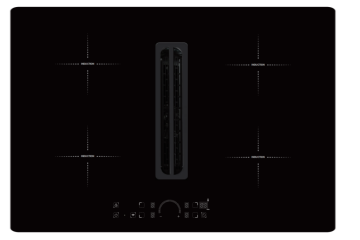
MZD supports four-zone extractor hob projects in 60cm and 90cm formats. Both I4 models provide 500 m³/h airflow, 7,000W total cooking power, Touch & Slide control, nine power levels, a timer and Booster functions.
- I4-60-PX1 60cm extractor hob with a 590 × 520 mm glass surface.
- I4-90-PX4 90cm extractor hob with a 900 × 520 mm glass surface.
Final dimensions, ducting configuration, filter arrangement and compliance requirements must be confirmed against the selected model documentation.
OEM and ODM Support for UK and European Projects
As an induction hob manufacturer based in Zhongshan, MZD works with appliance brands, distributors, importers and project buyers on product specification, configuration, samples, certification coordination and production planning.
OEM and ODM discussions can cover the destination market, required extraction configuration, cooking-zone layout, controls, packaging, labelling and technical documentation. Available options depend on the project and selected product platform.
Frequently Asked Questions
Does an integrated extractor require external ducting?
Not necessarily. Some extractor hobs can be configured for external ducting, while others support recirculation with suitable filters. Confirm the exact model’s installation instructions before specifying the ventilation route.
Can an extractor hob replace a conventional cooker hood?
It can be an alternative in suitable kitchen layouts, particularly islands and open-plan spaces. The final decision should consider extraction capacity, ducting or recirculation, maintenance access, cooking habits and the overall kitchen design.
Should I choose a 60cm or 90cm extractor hob?
Choose the size according to the worktop design, available cabinet space, cooking-zone requirements and installation dimensions. Compare both models at the same scale rather than assessing the glass surface dimensions alone.
Discuss Your Extractor Hob Requirements
Share the required hob size, destination market, extraction configuration, electrical requirements and estimated quantity with the MZD team. We can review the project and confirm the available OEM and ODM induction hobs, specifications and documentation.
ZHONGSHAN MINGZIDA TECHNOLOGY CO., LTD.
Induction Hob Manufacturer | OEM & ODM Cooperation