
An invisible induction hob conceals the heating module beneath a compatible stone, porcelain or engineered worktop. The cooking surface remains visually uninterrupted while the hob, controls, cooling path and countertop work together as one installed system.
MZD supplies invisible induction systems for UK kitchen projects, countertop fabricators, appliance brands and distributors. This guide explains how an invisible induction hob works, what must be checked before fabrication, and which product and technical information should be reviewed for a project.
Invisible Induction Hobs for UK Kitchen Projects
MZD currently presents 7000W four-zone and 9000W five-zone invisible induction systems for qualified OEM/ODM and kitchen projects. Both use a split heating-module and separate control arrangement. The countertop material, thickness, installation clearance, ventilation, controls and electrical supply must be confirmed for the exact model before specification.
The complete invisible induction hob range shows the current models available for project evaluation.
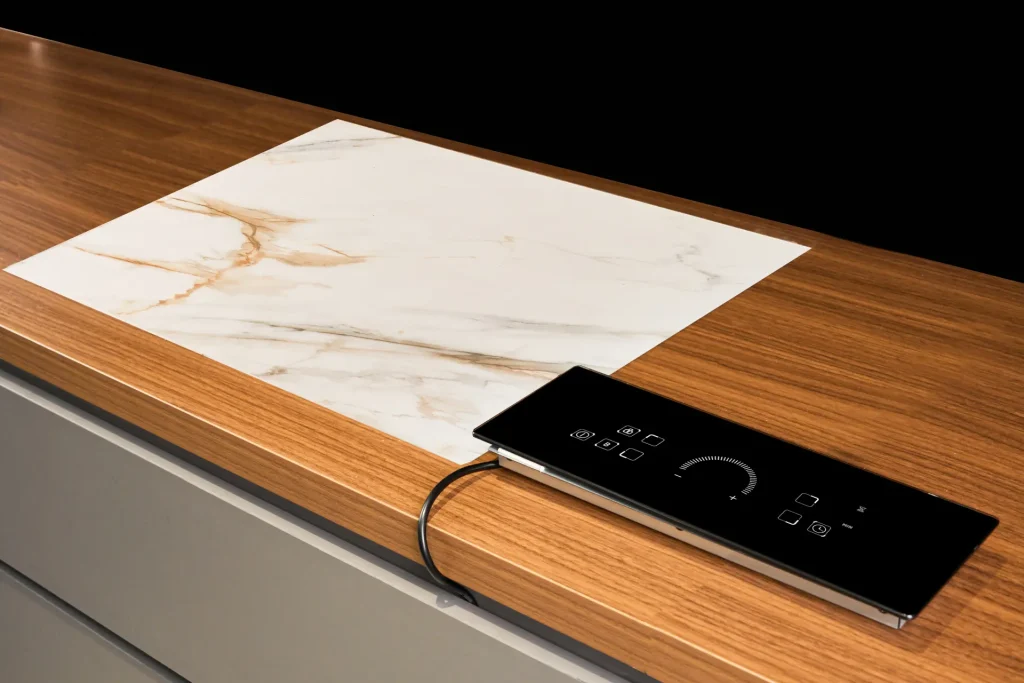
7000W 4-Zone Invisible Induction Hob for Compatible Stone and Porcelain Countertops
Four-zone induction hob with split-type design and remote control. Hidden installation compatible with granite or porcelain countertops (thickness 6–15mm). 9 power levels, 1–99 minute…
View product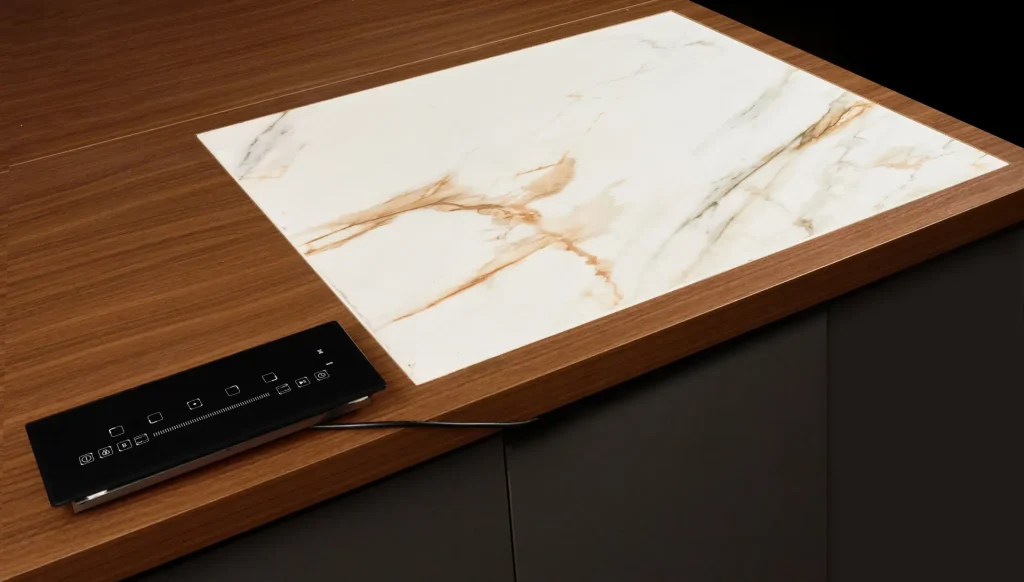
9000W 5-Zone Invisible Induction Hob for Compatible Stone and Porcelain Countertops
Five-zone induction hob with split-type design and remote control. Hidden installation compatible with granite or porcelain countertops (thickness 6–15mm). 9 power levels, 1–99 minute…
View productHow Does an Invisible Induction Hob Work?
An invisible induction system places an induction coil and heating module beneath a compatible countertop. A magnetic field passes through the countertop assembly to induction-compatible cookware. Because no conventional glass hob appears on the surface, the countertop becomes part of the complete cooking system.
The installed assembly relies on several components working together:
- Induction coils and the concealed heating module
- Electronic control board and separate control interface
- Compatible cookware with a suitable magnetic base
- Verified countertop material, thickness and support
- Cooling and ventilation path beneath the worktop
- Installation drawings, clearances and service access
For a component-level explanation, read how the main components work together or how invisible induction works.
Countertop Compatibility and Thickness
Invisible induction is not automatically compatible with every stone, porcelain or engineered countertop. Material composition, nominal thickness, tolerances, thermal-shock limits, support, coil-to-cookware distance and the finished assembly must all be assessed.
MZD’s project information references a 6–15 mm range for specific models. This is not a universal rule: the final range must always be confirmed against the exact model datasheet and countertop manufacturer’s guidance.
Useful references include sintered stone countertop compatibility, material compatibility and validation and invisible induction under sintered stone.
Installation, Clearance and Ventilation Requirements
The heating module, electrical components and control board generate heat below the worktop. The cabinet design must therefore preserve the required clearances and provide the ventilation path specified for the selected model.
- Confirm the approved coil-to-cookware distance
- Maintain the model-specific rear, side and underside clearances
- Provide the required cooling and ventilation openings
- Keep the control interface and service components accessible
- Confirm cable routing and the protective-device requirements
- Review the installation drawing before cutting or fabricating the worktop
Review installation structure and design coordination, installation clearance and safety requirements and thermal management and ventilation before fabrication.
Controls, CAD and Fabrication Coordination
Invisible systems normally use a separate control interface because there is no raised glass control panel on the worktop. The designer therefore needs to coordinate the control position, cable route, cut-outs, module support and maintenance access before the countertop is finished.
Technical teams can review CAD drawings and technical documentation and the questions for kitchen designers and countertop fabricators.
Hidden Induction Hob vs Invisible Induction Hob
Both terms generally describe induction equipment concealed beneath the work surface. Manufacturers and designers may use hidden, invisible, concealed or under-worktop terminology depending on the market. The important distinction is not the marketing name, but the verified countertop and heating-system assembly.
Advantages and Limitations
The main advantage is a clean, uninterrupted worktop with no raised glass cooking panel. Limitations include greater installation coordination, material-specific compatibility, ventilation requirements and the need to integrate controls and maintenance access into the design.
For buyers comparing a conventional built-in induction hob with an invisible induction cooktop, the complete installed solution matters more than the appliance module alone. Countertop fabrication, structural support, technical validation and service access can materially affect project cost and timing.
Invisible Induction Hob Price
Price depends on the number of zones, rated power, control arrangement, countertop requirements, documentation, packaging, order quantity and customization. Published price ranges should only be confirmed against current commercial terms for the exact model and project configuration.
You can review an example project in the French invisible induction hob import case study.
Frequently Asked Questions
Can an invisible induction hob be installed under any stone worktop?
No. The countertop manufacturer, series, composition, thickness, thermal limits and finished assembly must be checked against the selected model requirements.
Does the concealed module need ventilation?
Yes, when specified by the model. The module must be installed with the required thermal-management and ventilation arrangement shown in the approved installation documentation.
Can the controls be positioned separately from the heating module?
Suitable split-type models can use a separate control interface. Available configurations, cable routing and installation requirements must be confirmed for the exact product.
Can MZD support a CAD and countertop review?
MZD can review the proposed countertop material, thickness, installation arrangement and project requirements. Contact MZD with the applicable drawings and specification.
Request an Invisible Induction Hob Review
Send the countertop material and thickness, worktop drawing, required number of zones, destination market, control arrangement and estimated quantity to the MZD team for a model-specific review.